5 Rookie Mistakes New Oregon Real Estate Brokers Commonly Make
In Oregon, an entry-level real estate licensee is a broker, not an agent or salesperson. A principal broker supervises brokers. A managing principal broker is a principal broker who registered, or assumed responsibility for, a registered business. An authorized principal broker is the managing principal broker or an associated principal broker assigned the applicable supervisory responsibility through a written supervisory agreement. These are common compliance risks, not a statistical ranking of Oregon Real Estate Agency (OREA) enforcement actions. Good habits can help you avoid them.
Why Your First Year Matters
Oregon law prohibits professional real estate activity, or advertising that you do it, without an active license. Passing the exam doesn't authorize practice. Your license must be issued, active, and associated with a registered business before you show a home, write an offer, or post a listing. If it expires or becomes inactive, you can't practice. The late-renewal window isn't permission to keep working.
Mistake 1: Burying the Brokerage in Advertising
The registered business name is the brokerage name registered with OREA. Use it exactly as registered and make it immediately noticeable in every ad. Before advertising property for sale, exchange, or lease, get written permission from the owner or authorized agent. Don't guarantee future profits. Discipline may result from knowingly or recklessly publishing materially misleading or untruthful ads. Misleading credentials, including wording that suggests you are a managing principal broker when you aren't, can also create risk.
Team names, logos, and electronic ads, including social media, websites, and texts, don't replace the registered business name. A one-click link may not meet visibility requirements in every format, so ask your principal broker.
Example: A new Portland broker posts an Instagram listing photo with a large team logo at the top and tiny gray brokerage type at the caption's bottom. Scrolling viewers may notice the team, not the brokerage, so the ad may fail the immediately noticeable standard.
Teams need managing principal broker approval, and OREA doesn't register team names. Since January 1, 2026, a team disclosure form has been required before written representation or listing agreements are signed. Legislation delayed the ban on “realty” or “real estate” in team names until July 1, 2027.
Mistake 2: Delaying the Initial Agency Disclosure Pamphlet
Oregon requires delivery of the Initial Agency Disclosure Pamphlet at first contact, meaning the point when you have enough contact information to provide it. First contact may happen by phone, email, internet, or in person, but the pamphlet itself must be delivered physically or electronically, as an email attachment or link. Explaining it on a call doesn't count as delivery. Build delivery into lead intake through a customer relationship management system (CRM) so a new lead receives it automatically. Record the delivery time or add a note to the file.
The pamphlet isn't a disclosed limited agency agreement. Disclosed limited agency applies when a licensee or brokerage represents both buyer and seller or competing parties with written consent. That agreement must be written, signed, and dated.
Mistake 3: Mishandling Earnest Money
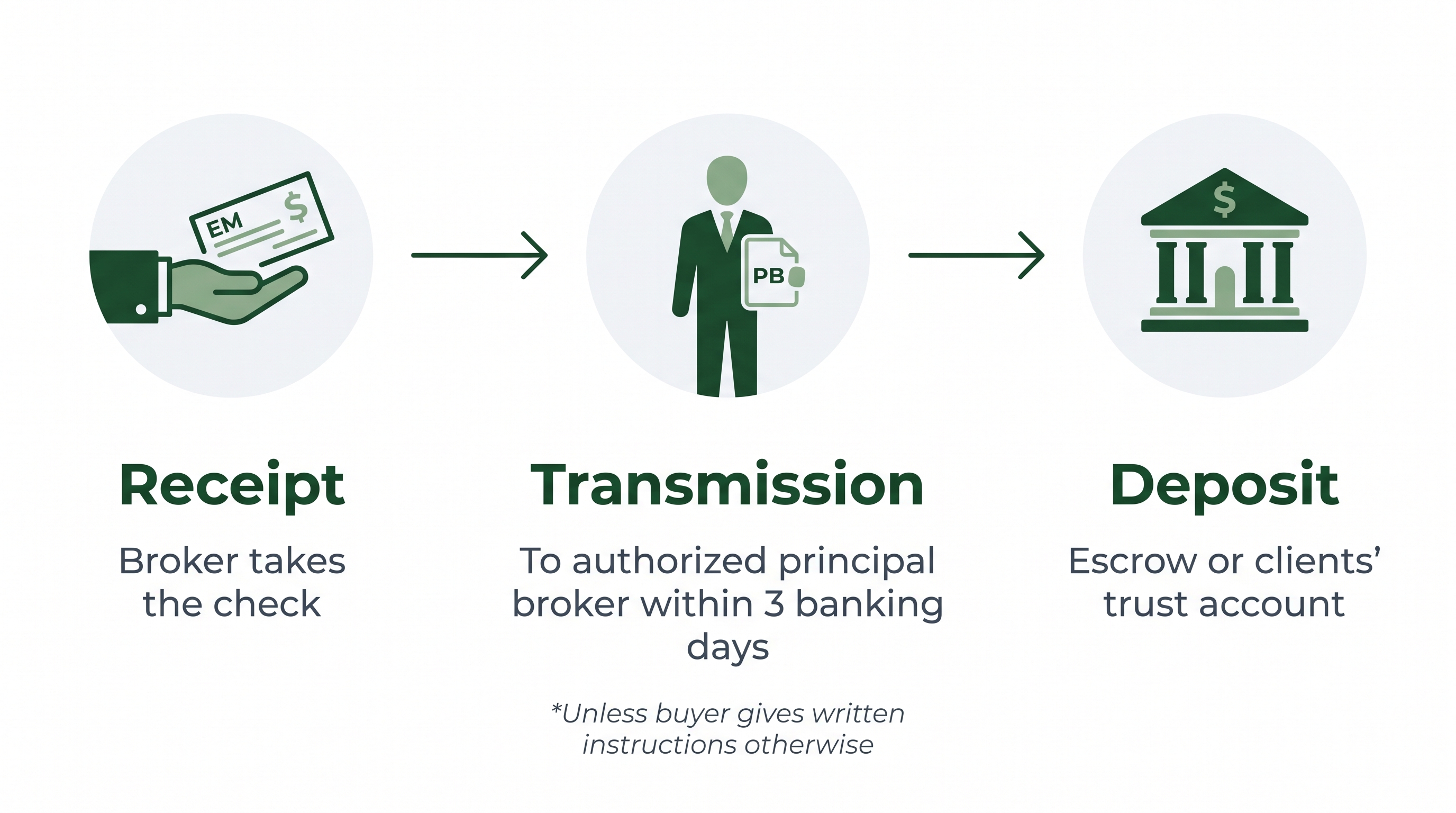
When you receive earnest money, deliver it to your authorized principal broker within three banking days, unless the buyer gives written instructions otherwise, such as directing that funds go directly to escrow. Banking days exclude Saturdays, Sundays, and legal holidays.
Think in three steps. Receipt is when you take the check; transmission is when you hand it to the authorized principal broker; deposit is when funds go into escrow or a clients' trust account. That account is separate from operating funds and holds money belonging to clients and others.
Example: You receive a check Friday, and Monday is a legal holiday. The weekend and holiday don't count. If Friday counts as day one, the third banking day is Wednesday; if it doesn't, the third banking day is Thursday. Treat Wednesday as your deadline. Ideally, hand off the check the same or next banking day, log the handoff, and confirm your brokerage's counting method.
Independent contractor status doesn't mean working without supervision. Oregon requires principal brokers to supervise associated brokers. Know who your authorized principal broker is for each activity.
Mistake 4: Accepting Compensation Directly
An associated licensee may accept compensation for professional real estate activity only from the managing principal broker with whom they're associated. That rule covers well-meant gestures. If a seller offers a $1,000 “closing bonus,” or a buyer gives you cash or a gift card for your work, don't accept it directly. Route it through the brokerage. A narrow exception permits certain compensation sharing with 501(c)(3) charitable organizations; read the rule carefully before relying on it.
The reverse also matters: don't pay unlicensed assistants for work that requires a license.
Mistake 5: Missing First Renewal and Recordkeeping Duties
Broker continuing education (CE) requirements effective January 1, 2026, total 30 hours:
| Course | Hours |
|---|---|
| Broker Advanced Practices (BAP) | 26 |
| Law and Rule Required Course (LARRC) | 2 |
| Fair Housing (state and federal) | 2 |
| Total | 30 |
Legacy 26- or 27-hour BAP courses and 2- or 3-hour LARRC courses are accepted during the transition; confirm your situation with OREA. Legislation also created a proficiency assessment, with components specified in rule beginning July 1, 2026. Take courses only from approved providers and enter them in eLicense.
Renewal opens on the first day of your expiration month. OREA reminders are a courtesy, but you're responsible for renewing on time. CE hours don't carry over to the next cycle.
Keep CE certificates for three years from your renewal date. Transaction records are governed separately and maintained by the brokerage. They include failed deals and rejected offers, as well as relevant texts and emails. Send copies to the brokerage promptly.
First-90-Days Compliance Checklist
These are recommended internal controls, not statutory requirements:
- Verify your license is active and associated with your registered business before activity.
- Learn the exact registered business name.
- Ask your principal broker to review social profiles, website, email signature, and business cards.
- Get written permission from the owner or authorized agent before advertising property.
- For teams, confirm managing principal broker approval and use the required disclosure form.
- Automate pamphlet delivery through your CRM.
- Confirm your authorized principal broker and earnest-money handoff process.
- Route compensation, gifts, and bonuses through the brokerage.
- Calendar renewal month and CE plan; save certificates; forward transaction communications to the brokerage file.
What's at Stake
OREA may reprimand, suspend, or revoke a license and impose civil penalties. A compliance error can also damage client trust and your principal broker's confidence.
Three steps for this week:
- Ask your principal broker to review one ad, such as your latest social post.
- Confirm your CRM sends the pamphlet automatically at intake.
- Put your renewal date and brokerage funds-handoff process somewhere visible each day.
Disclaimer
This article is for general education, not legal advice. Oregon real estate law changed in 2026 and continues to evolve. Confirm current requirements with your principal broker and OREA.